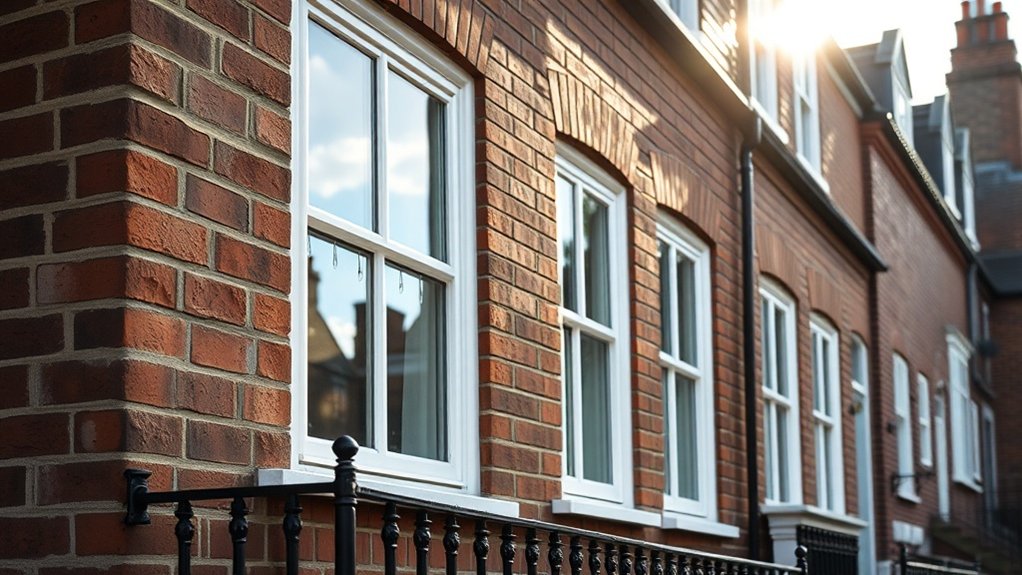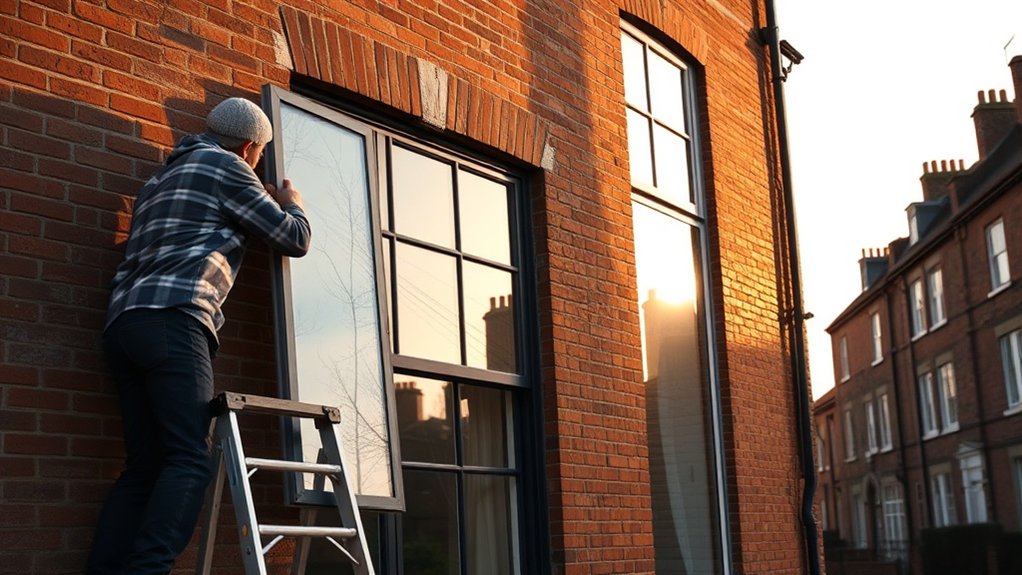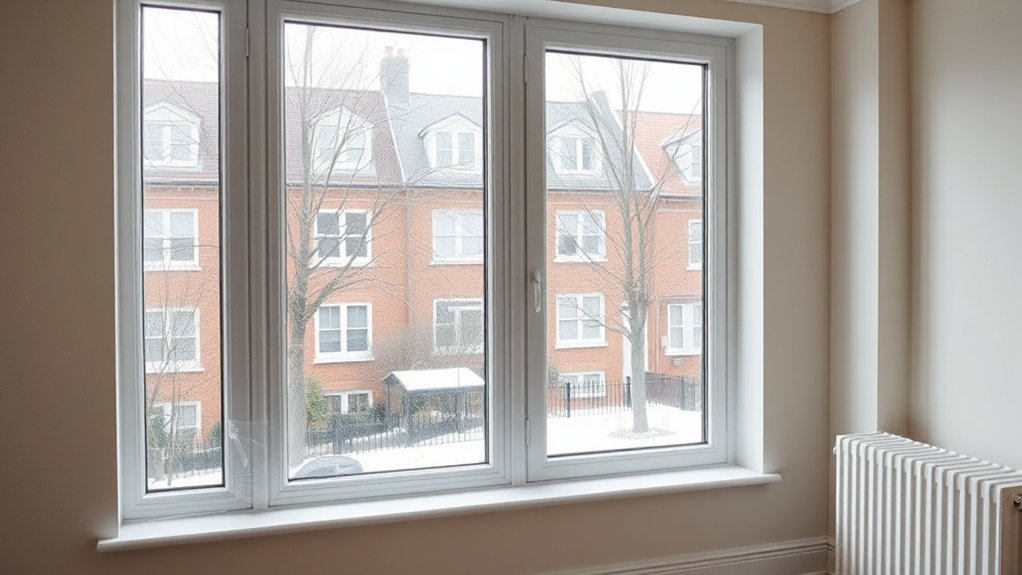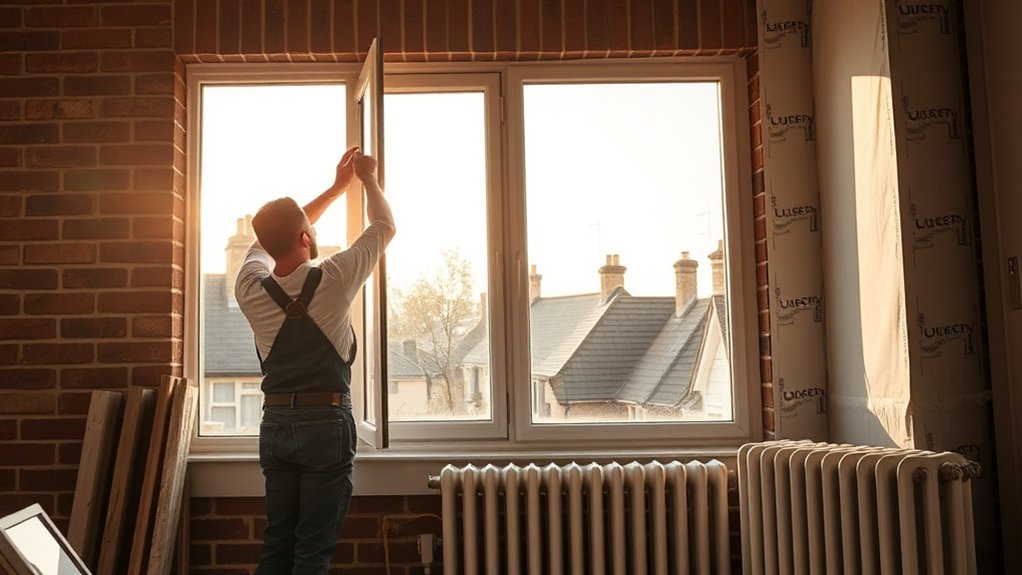
Fitting energy efficient glazing in Bickley pays back in three ways at once: lower heating bills, a better EPC band and a house that feels warmer in January and cooler in July. Our rule of thumb for replacement windows is a whole-window U-value of 1.2 W/m²K or better, a g-value between 0.35 and 0.55 depending on the elevation, and test evidence to EN 14351-1 and EN 1279 rather than a brochure claim.
Key insights
- For replacement windows in England, Part L sets a ceiling of 1.4 W/m²K; we aim for 1.2 W/m²K or lower and a Window Energy Rating of B or above.
- Low-e glass, an argon-filled cavity and a warm-edge spacer do most of the work, cutting window heat loss by well over half compared with single glazing.
- South and west elevations in Bickley need a lower g-value or some shading, or you swap a cold house for an overheated one.
- Laminated acoustic glass with an Rw of 40 dB or more tackles road and rail noise without hurting thermal performance.
- Conservation areas and listed homes usually call for slimline units or secondary glazing, and the planning conversation should happen before you order.
- A FENSA or CERTASS installer self-certifies the work and supplies the paperwork a buyer's solicitor will ask for.
How Energy Efficient Glazing Works in Bickley, BR1
A modern sealed unit is a small insulation system rather than a sheet of glass. Three numbers describe it: the U-value, which measures heat escaping through the whole window; the g-value, which measures how much of the sun's energy gets in; and air permeability, which measures draughts around frame and sash. Part L limits the first and third; Part O covers the second.
The glass carries a microscopically thin low-emissivity coating that bounces room heat back inwards while daylight passes through. The cavity is filled with argon, or krypton in very slim units, which conducts heat far more slowly than air. A warm-edge spacer replaces the old aluminium strip at the perimeter, the cold bridge that makes older double glazing stream at the edges on winter mornings.
Solar control comes from a different coating that filters infrared while leaving visible light alone, so a south-facing bay stays bright without becoming a greenhouse. Tight gaskets and foam-sealed reveals then deliver the airtightness that a SAP assessment rewards.
How to Choose the Right Glazing for Bickley Homes
Start with the numbers, not the showroom sample. Look for a certified whole-window U-value no higher than 1.2 W/m²K and a Window Energy Rating of B or better. That clears the 1.4 W/m²K Part L limit and leaves headroom for future tightening.
Treat each elevation separately. A north-facing kitchen in a Bickley terrace wants a g-value around 0.5 to 0.55 so it collects whatever winter sun it can. A west-facing living room with a large picture window wants nearer 0.35 to 0.4 plus a decent blind, because afternoon sun is what makes rooms unbearable in a heatwave.
Before signing, ask for the EN 14351-1 and EN 1279 test certificates and confirm the installer is FENSA or CERTASS registered so the job is self-certified to Building Control.
Double vs Triple vs Secondary Glazing in Bickley, BR1
Each option solves a different problem. Good low-e double glazing in Bickley lands around 1.2 to 1.4 W/m²K, which satisfies Part L and suits most semis and terraces. Triple glazing drops to roughly 0.8 W/m²K but each unit is a third heavier, so hinges and frames need upgrading, and the extra pane adds cost and embodied carbon. Secondary glazing leaves the original window in place and adds a discreet inner pane on the room side.
Triple glazing earns its premium on exposed sites, very large panes and next to busy roads or railways, where the third pane also helps with noise. Secondary glazing comes into its own in period property and conservation areas: the Victorian sashes stay, the street elevation is untouched, and with a low-e inner pane and a 100 mm gap the combined window can still get below 1.5 W/m²K.
Choosing Frame Materials for Energy Efficient Windows in Bickley
The frame makes up a fifth to a third of the window area, so a poor frame drags down an excellent glass unit. Compare whole-window U-values rather than the centre-pane figure on the glass sticker, and ask about the Psi-value at the glass edge and the air permeability class. These are the numbers a SAP assessor uses for a Bickley property.
Aluminium gives the slimmest sightlines and a finish that lasts decades, but it conducts heat readily, so only profiles with a deep polyamide thermal break and foam-filled chambers reach 1.2 W/m²K. Timber insulates naturally and has the lowest embodied carbon, provided you repaint every eight to ten years. Aluminium-clad timber combines both and is popular on Bickley extensions.
uPVC remains the value option and performs well in standard openings. On wide bifolds or tall sashes, specify multi-chamber profiles with thermal inserts or glass-fibre reinforcement rather than steel, which acts as a cold bridge through the frame.
Warmth vs Daylight: Keeping Bickley Homes Bright and Cosy
A window that keeps heat in must not turn the room gloomy. In Bickley, BR1, Part L penalises heat loss and Part O penalises overheating, and the local plan leans on both. The aim is winter solar gain, low heat loss and a daylight factor above the usual 2% target, all in one unit.
For a south-facing elevation we usually specify low-e double or triple glazing with a g-value of 0.4 to 0.6, so low winter sun still contributes useful warmth. East and west faces get the higher end only where an overheating assessment allows it. Selective coatings let the visible spectrum through while rejecting the infrared that carries most of the heat.
If a customer asks for tint or solar film, we steer them to products with visible light transmission of at least 60%, otherwise the room reads as dull even on a bright day.
Preventing Overheating and Excess Solar Gain in Bickley Flats
Our climate is heating-led most of the year, but a top-floor Bickley flat with floor-to-ceiling glass facing south-west can hit 30°C indoors on a July afternoon. Part O applies an overheating test to new residential buildings, and planning officers increasingly ask for evidence on conversions too.
Meeting the CIBSE TM59 criteria usually needs glass, shading and controls together:
- Solar control double or triple glazing with a selective coating and a g-value nearer 0.3 than 0.5 on hot elevations.
- External shading such as brise-soleil, deep reveals or louvres, backed up by internal blinds.
- Automated blinds and vents driven by sun sensors and room temperature, so the flat responds while you are at work.
- Sensible glazing-to-wall ratios decided at design stage rather than patched later with film.
- Frames and coatings chosen so the performance spec does not spoil the look of the building.
Cutting Traffic Noise With Energy Efficient Glazing in Bickley, BR1
Many of the windows we replace in Bickley face a main road, bus route or railway, and the customer wants quiet as much as warmth. A well-specified unit can take 30 to 45 dB off the noise coming through the glass while still meeting Part L and Part O. The tools are laminated acoustic glass, wider cavities and asymmetric pane thicknesses, and the skill is knowing how each affects both the sound reduction index (Rw and Rw+Ctr) and the U-value, so you do not improve one at the expense of the other.
How Glazing Reduces Noise
Sound is vibration, and a single pane vibrates like a drum skin. Reducing noise means interrupting that vibration at several points between the street and the sofa. We design to BS 8233 for indoor noise levels and, where overheating is a concern, Approved Document O, because a window that must stay shut for quiet also needs to control solar gain. Done well, you get measurable dB reductions without losing daylight.
The mechanisms that do the work:
- A laminated pane with an acoustic interlayer that absorbs vibration instead of passing it on.
- Panes of different thickness, for example 6.4 mm laminated outside and 4 mm inside, so no single frequency sails through both.
- A cavity deep enough to avoid resonance, with gas fill tuned for heat and sound.
- Stiff frames and continuous compression seals, because a 2 mm gap around a sash lets in more noise than the glass does.
- Solar control or tinted coatings where needed, which have no effect on the acoustic figures.
Choosing Acoustic Glass
"Acoustic glass" on a quote means little on its own. For a Bickley project we first set the target indoor level from BS 8233 and WHO guidance, then convert that into the Rw+Ctr the window must achieve on each elevation and floor. Only then do we pick a glass make-up with test data for that exact configuration.
Laminated glass with an acoustic PVB interlayer is the first choice because it performs best in the 100 to 3150 Hz band where traffic noise sits. The glass is only one part of the system: frame stiffness, gasket quality and how carefully the unit is packed into the reveal decide what you hear. We therefore quote figures from whole-window tests to BS EN ISO 10140, not glass-only laboratory numbers.
Balancing Quiet and Efficiency
Heavy acoustic glass makes a unit thicker and heavier, and it is easy to drift outside the Part L and Part O limits while chasing silence. Acoustic performance is one input to the specification, not the whole of it.
In practice we pair laminated acoustic panes with a low-e coating, argon fill and good seals, then add controls where the budget allows. A typical Bickley main-road specification:
- A target Rw of 40 dB or more, with the whole-window U-value held at 1.4 W/m²K or better.
- A low-iron outer pane and a selective coating to keep the g-value comfortable on sunny elevations.
- Switchable glass on large panes where the client wants shading without blinds.
- A spectrally selective film to tame glare without darkening the room.
- Performance checked against EN ISO 10052 and BS EN 410 data before the order is placed.
Bickley, BR1 Building Regulations and Part L for Windows
Any window replacement in Bickley has to comply with Approved Document L, which gives numerical targets for U-values, solar gain and air leakage. The targets differ between a new build, an extension and a like-for-like replacement, and the principle is that an upgrade never leaves the dwelling using more energy than before. With the product data and installation paperwork in hand, compliance is routine.
Key Part L Requirements
In plain terms, Part L wants the window to lose little heat, admit a sensible amount of sun and not leak air, while still giving the room adequate daylight. For most houses in Bickley that means a certified whole-window U-value of 1.4 W/m²K or better, achieved with a low-e coating, a warm-edge spacer and an insulated frame.
The figures to keep an eye on:
- The whole-window U-value, including frame and edge, rather than the centre-pane number.
- The g-value, which feeds into overheating risk.
- The air permeability class of the window.
- The area-weighted average U-value where several elevations are replaced at once.
- Consistency with the SAP calculation and any overheating assessment.
Compliance For Window Upgrades
Replacing a window is controlled work under the Building Regulations, so the new unit must meet the current standard outright; being better than the old single glazing is not enough. For a domestic replacement in England that means a certified whole-window U-value of 1.4 W/m²K or lower (the exact limit depends on the edition of Approved Document L and the project type), or a SAP calculation showing the dwelling still meets its carbon and primary energy targets.
You also need the g-value and airtightness figures, particularly where large glazed areas or solar film are involved; any coating or film must appear in the manufacturer's data or the SAP model. The easy route is a FENSA or CERTASS installer who self-certifies and lodges the job. Otherwise you apply to Bickley Building Control for an inspection and completion certificate.
Planning Rules for Conservation Areas and Listed Bickley Homes
Thermal performance is only half the conversation in Bickley, BR1's conservation areas and on listed buildings, where a window change is a heritage decision before it is a technical one.
The constraints we meet most often:
- Listed Building Consent under the Planning (Listed Buildings and Conservation Areas) Act 1990 before any window is replaced or double glazing inserted into an existing frame.
- Article 4 directions in conservation areas that bring frame sections, sightlines and glazing bars under planning control.
- A strong officer preference for repair, like-for-like timber or slimline heritage units over standard uPVC.
- Evidence that U-value, g-value and noise gains are achieved without changing how the façade reads from the street.
- A pre-application chat with the conservation officer, and a heritage consultant on larger jobs, to avoid a refusal after the windows are ordered.
Costs, Savings and Payback Periods for Bickley Properties
Before committing to energy efficient glazing in Bickley, you want three figures: a realistic installed cost by window type and frame, an estimate of the annual heating saving based on your EPC and current glazing, and the payback period that falls out of the two. A free survey turns the ranges below into a firm quote for your own property.
Typical Installation Cost Ranges
What a window costs in Bickley depends on glass specification, frame material, the size and number of openings and whether we work within existing reveals or strip back to brickwork. As a guide, Part L compliant uPVC double glazing typically runs £450 to £750 per window supplied and fitted. Triple glazed units in aluminium or composite frames usually sit between £900 and £1,400 each, with bifolds and bays priced individually.
The main things that move the price:
- Frame material, in ascending order: uPVC, aluminium, then timber or aluminium-clad timber.
- Glass specification: double or triple, low-e, argon fill, warm-edge spacer.
- Access: second-floor work, scaffolding, parking restrictions on tight Bickley streets.
- Heritage detailing such as putty-line glazing bars or sash horns in conservation areas.
- Compliance extras: toughened or laminated safety glass, acoustic laminates, trickle vents and certification.
Energy Savings Estimates
Price is only half the equation; what most Bickley, BR1 homeowners want to know is how fast new windows claw the money back through a smaller gas bill. The sensible starting point is the EPC for the property and local degree-day data, which captures how cold a Bickley winter actually is.
Take a pre-2000 semi with single glazing at roughly 4.8 W/m²K. Moving to low-e argon-filled double glazing at around 1.2 W/m²K typically cuts heat loss through the windows by 55 to 65%. In a gas-heated home that usually means a 12 to 18% drop in annual space-heating use, assuming the rest of the fabric stays as it is.
Triple glazing at about 0.8 W/m²K may add a further 5 to 8%, with the biggest gains on exposed elevations. Those savings only hold if the units keep their argon and seals for a 25 to 30 year life, which is why we specify EN 1279 tested units with a ten-year insurance-backed guarantee.
Payback Period Calculations
A payback period is all the costs on one side, the savings on the other, and a division. List every outlay, estimate the annual benefit under today's tariffs and a plausible future tariff, and see how many years it takes to break even.
The model we use with Bickley customers:
- Capital cost: windows, fitting, making good, certification and a small contingency.
- Annual saving: the kWh reduction multiplied by your blended gas and electricity unit price.
- Regulatory value: the EPC uplift, MEES thresholds for landlords and the likelihood of Part L tightening again.
- Running costs: occasional hinge and seal checks, minor but real.
- Payback: total investment divided by net annual saving, then re-run with a 5% and 10% tariff rise to test sensitivity.
The result is a figure you can defend to a surveyor or lender, and it is usually shorter than people expect once the EPC uplift is included.
How to Choose an Energy Efficient Glazing Installer in Bickley
Price and a glossy brochure are not enough when choosing an installer in Bickley, BR1. Check for FENSA, CERTASS or MCS registration so the work is self-certified under Part L, and ask whether they understand Part O if your project has large glazed areas. Insist on whole-window U-values, g-values and air permeability figures for the exact products quoted, because centre-pane data flatters the result.
A good firm talks comfortably about low-e coatings, warm-edge spacers, argon fills and solar control, and can show EPC improvements on recent Bickley jobs. Confirm the guarantee is insurance-backed and covers units and workmanship, and ask whether they coordinate with an airtightness tester on bigger refurbishments.
Practical Tips for Upgrading Existing Windows in Bickley Homes
Full replacement gives the biggest gain, but there is plenty you can do to an existing window in Bickley if budget or planning rules out new frames. Every intervention still needs to respect Part L, and in conservation areas the external appearance must stay as it is.
- Fit secondary glazing with a low-e inner pane; it lowers the U-value and stops draughts without touching the outside of the building.
- Renew perimeter seals and add brush or compression draught strips to sashes and casements as routine maintenance.
- When sealed units are swapped in existing frames, choose warm-edge spacers to reduce edge condensation.
- Add Part F compliant trickle vents so the house stays ventilated once the draughts are gone.
- Apply a solar control film with high visible light transmission to south-facing panes that overheat.
Frequently Asked Questions
Can Energy Efficient Glazing Help Reduce Condensation and Mould in Bickley Homes?
Yes. Condensation forms where warm, moist indoor air meets a cold surface, and single glazing is usually the coldest surface in the room. A low-e unit with a warm-edge spacer keeps the inner pane and its edges several degrees warmer, so moisture stays in the air rather than running down the glass and feeding mould on the frame and reveal. We pair new windows with trickle vents that meet Part F, because a tighter house still needs to breathe.
How Does Energy Efficient Glazing Impact Property Value in Bickley, BR1?
New compliant glazing usually lifts the EPC band, and in Bickley that matters to buyers, lenders and especially landlords facing MEES minimum rating rules. Surveyors look for the FENSA certificate and guarantee, and a house with documented U-values and a valid warranty avoids the price chip that follows a "windows need replacing" note in a homebuyer's report. Lower running costs and a tidy frontage make a property easier to sell or let at the asking price.
Is There Eco-Friendly or Recyclable Energy Efficient Glazing Available in Bickley?
It is, and it is becoming the norm. Float glass already contains recycled cullet, and the major manufacturers publish Environmental Product Declarations to EN 15804 for their coated glass and sealed units. Ask for warm-edge spacers made from recyclable composites, argon rather than exotic gases, and frames with a take-back scheme; uPVC is widely recycled in the UK and aluminium almost indefinitely. We can specify units that satisfy Part L and BS EN 1279 while keeping the embodied carbon of the job as low as the brief allows.
Can I Get Green Grants or Incentives for Energy Efficient Glazing in Bickley?
Sometimes, but the schemes change often and most target insulation and heating first. ECO4 and the Great British Insulation Scheme can fund glazing in lower-income or low-EPC households when it forms part of a wider retrofit, and Bickley council runs occasional retrofit programmes with their own criteria. All of them require an EPC, a registered installer such as a FENSA member and products that meet Part L. We will tell you at survey stage whether you are likely to qualify.
How Does Energy Efficient Glazing Perform in Bickley’s Older, Draughty Housing Stock?
Very well, and the older the house the larger the improvement, because single glazing and loose sashes are where most of the heat goes. Replacing or secondary glazing a Victorian terrace in Bickley typically cuts window heat loss by around 60% and removes the draughts and condensation that come with it. On the heritage side we use slimline double glazing or secondary units so the original sash pattern survives, and where Listed Building Consent is needed we handle the application, using low-e glass, warm-edge spacers and a sealed installation that meets Part L without harming the historic fabric.
Summary
Energy efficient glazing in Bickley is a fabric upgrade that cuts heat loss, controls summer sun and improves the EPC in one go. Choose the right U-value and g-value for each elevation, pick a frame that suits the house and the planning context, and let a FENSA registered installer handle compliance so the paperwork satisfies Part L and the Bickley, BR1 local plan. For firm numbers on your own property, call us for a free, no-obligation survey and quote. For anything else glass-related, Bickley Glazing is the one number to keep: free quotes, 24/7 emergency cover and FENSA-certified installations.