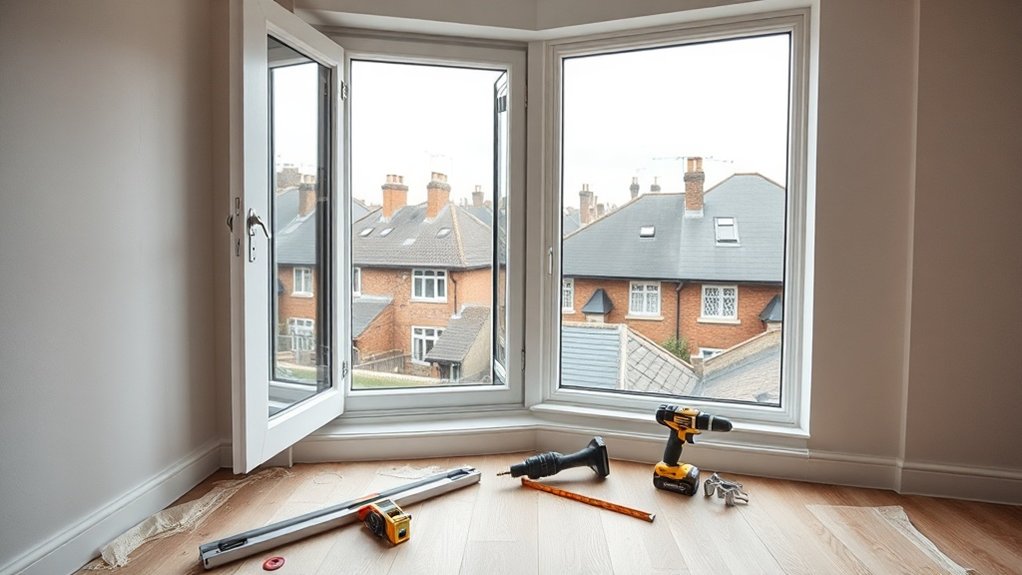
Tilt and turn windows give a Bickley home two windows in one: a top-hinged tilt for secure background ventilation and a full inward swing for purging a room, escaping in a fire or cleaning the outside pane from indoors. Fitted properly they seal tighter than most casements, resist forced entry and keep traffic noise down. The hard part is the detail: an accurate survey, the right frame material (uPVC, aluminium or timber) and careful packing, fixing and sealing so the sash never drops or lets draughts in. Below we explain how we design, measure and install tilt and turn windows across Bickley.
Key insights
- Use an installer who knows tilt and turn hardware and the relevant parts of the Building Regulations: Part L for energy, Part F for ventilation, Part B for escape.
- Insist on a survey that records widths, heights, diagonals, reveal depths and cill falls, because the sash only seals if the frame is square.
- Pick uPVC, thermally broken aluminium, timber or a hybrid, with double or triple low-E or acoustic glass matched to the elevation and noise level.
- Specify tilt-only night ventilation, key-lockable handles and multi-point locking for ground floors, accessible roofs and homes with children.
What Are Tilt and Turn Windows and How Do They Work?
From the street a tilt and turn window looks much like a casement. The difference is in the hardware. A dual-action hinge system lets the sash lean inwards from the top for ventilation, or swing fully inwards on side hinges like a door for cleaning and maximum airflow. A single handle does both jobs: a quarter turn tilts the sash and a half turn releases it to swing open.
Hidden in the sash rebate is a run of steel gearing that throws locking points around the whole perimeter when the handle is closed, which is why these windows are so airtight and difficult to force. Frames come in thermally broken aluminium, multi-chamber uPVC or composite sections, each with its own balance of rigidity, insulation and sightline width.
Why Tilt and Turn Windows Suit Bickley, BR1 Homes and Flats
Homes and flats in Bickley tend to share the same constraints: rooms that cannot spare floor space for a swinging sash, a need for fresh air without leaving the house open, and security concerns on ground floors or near flat roofs. Tilt and turn windows deal with all three in one unit.
Space-Saving Window Design
In a small Bickley flat every centimetre of wall counts. Because a tilt and turn sash opens inwards in two set positions, there is no outward swing to worry about, so a window can sit above a kitchen worktop, behind a sofa or beside a radiator without clashing. The sash compresses against gaskets on all four sides, which allows narrower profiles than many outward-opening systems and therefore a larger pane for the same opening.
Improved Ventilation Control
Cooking, showers, drying washing and a full house all push up humidity and CO₂. In the tilt position the sash opens a few centimetres at the top, so warm stale air leaves at high level and fresh air arrives slowly, with little draught felt at sitting height. That is enough to keep condensation off the glass in a bedroom overnight. When you need a quick change of air, the turn position opens the whole aperture. Some hardware includes a stepped tilt setting so you can choose a smaller gap in winter and a wider one in summer.
Enhanced Urban Safety
On a busy street in Bickley, BR1, with shops below and flat roofs or bin stores within reach, a traditional casement on a single stay is an easy target. A tilt and turn sash locks at several points around the frame into a reinforced profile, so it resists levering from outside. In tilt mode the opening is too small to climb through, which makes it the right setting for overnight ventilation in a ground-floor flat or a child’s bedroom.
From inside, the full turn gives a clear, unobstructed opening that meets modern escape requirements under Approved Document B, and you can wash the outside of the glass from the room. The profiles are strong enough to carry laminated or toughened glass, acoustic gaskets and restrictors, so they work well on balcony doors and Juliet balcony openings.
Tilt and Turn vs Sash and Casement: Which Is Best for Bickley?
Choosing between tilt and turn, sliding sash and casement windows for a Bickley property comes down to measurable things: how much room each needs, how well it ventilates, how secure it is, how much noise it blocks and how airtight it stays over time.
Space, Ventilation And Safety
The tilt setting provides trickle-level ventilation without projecting into the street or snagging blinds and radiators. Swing the sash fully inwards and you have maximum purge ventilation and safe access to the outer pane without leaving the room. A sliding sash, by comparison, relies on partial lifts that can leave a low, wide gap a toddler could reach, and an outward-opening casement can hit walkways, scaffold or passers-by and usually carries fewer locking points.
Noise, Draughts And Insulation
Tilt and turn sashes close against continuous compression gaskets and are pulled tight by multi-point locks, producing an airtight seal that most sliding sashes and entry-level casements cannot match.
- A flat on a main road fitted with triple gaskets and argon-filled double glazing sees traffic noise drop to a background hum.
- A corner house exposed to crosswinds can vent in the tilt position without the draughts a cracked-open casement would let through.
- A clean modern façade with concealed hinges keeps its sightlines uninterrupted while the hardware is rated for decades of daily use.
Maintenance, Cleaning And Style
Cleaning the outside of the glass from indoors is a real advantage in an upper-floor flat where external access means hiring a cleaner with a reach pole. Most tilt and turn frames are supplied in uPVC or powder-coated aluminium, so there is no repainting cycle to budget for, unlike timber sashes and casements, and the continuous seals keep grit out of the rebates. Visually, tilt and turn profiles suit contemporary elevations with large panes and narrow frames; on a conservation-area street a heritage sliding sash or a flush casement will usually be the better match for the neighbours and the planning department.
Safety, Security, and Child-Safe Ventilation With Tilt and Turn Windows
In the tilt position the opening is limited to a narrow gap, so you can ventilate without creating a fall risk or an entry point for intruders. For families, key-lockable handles and restrictors stop a child switching from tilt to full turn. Multi-point locking, steel reinforcement in the frame and mushroom-headed cams resist prying, which matters on ground floors and anywhere a flat roof gives access. Internal glazing beads mean the glass cannot be removed from outside, and night-vent positions keep background air moving while the perimeter stays locked.
Best Frame Materials for Tilt and Turn Windows in Bickley
Choosing a frame material for tilt and turn windows in Bickley means weighing thermal performance, rigidity, upkeep and cost against the planning status of the building and how exposed it is. The usual candidates are modern uPVC, thermally broken aluminium, engineered timber and aluminium-clad timber hybrids.
- A slim aluminium frame with a polyamide thermal break gives a sharp look on a contemporary elevation and shrugs off pollution and wind loading on upper floors.
- Engineered timber, factory-finished for durability, satisfies conservation officers on period streets while keeping sightlines authentic and finely proportioned.
- A hybrid frame puts timber inside for warmth and decorating flexibility and aluminium outside for a crisp, low-maintenance shell that meets current energy standards in Bickley, BR1.
Glazing Options for Tilt and Turn Windows: Insulation and Noise Control
With the frame decided, the glass does most of the work on heat loss and noise. Double glazing suits most elevations; triple glazing earns its extra weight on north-facing rooms and homes aiming for the lowest U-values. For a Bickley flat on a bus route, an acoustic laminated unit with panes of different thicknesses breaks up sound frequencies better than a standard sealed unit of the same depth.
Low-E coatings and warm-edge spacers reduce heat loss at the centre and edge of the pane, and argon or krypton fill slows convection within the cavity. On large sashes and exposed elevations choose toughened or heat-strengthened glass. Keep the glass weight within the limits of the hinges and gearing, otherwise the sash will drop over time, the seals will leak air and the tilt mechanism will stiffen.
Planning Rules and Building Regulations for Tilt and Turn Installation in Bickley
Check that planning rules and Building Regulations in Bickley allow what you want before you order. There are three layers to consider: conservation constraints on the appearance of the elevation, fire and safety performance of the opening, and the thermal and acoustic standards the new units must meet.
- On a street of period façades, local guidance may dictate sightlines, glazing bar widths and colours, pushing you towards slimline tilt and turn profiles that read like the originals.
- Where a window serves as an escape route, opening angle, restrictors and handle height have to satisfy Part B while still allowing a secure night-vent tilt.
- On an upper floor you may need to check wind loads, limiter hardware and trickle vents against Parts F, L and O for ventilation, energy and overheating.
Tilt and Turn Window Installation in Bickley, BR1: Step-by-Step Process
From survey to finished window, a Bickley tilt and turn installation follows a set order that protects the structure, the new frame and the weather seal. The survey records the structural width and height at three points each and both diagonals, so we work from the smallest readings and spot any racking, bowed lintels or cills that could put the sash under strain. We prepare the opening first: the old unit comes out, the masonry is checked for loose brick or crumbling mortar, and a level, plumb datum is set that respects the existing building and its neighbours.
- The frame is set on packers, the diagonals are checked, and temporary fixings go through the reinforced zones with an expansion gap left for thermal movement.
- Permanent mechanical anchors suited to brick, block or stone are driven, then the joint is sealed with airtight tape inside and a weatherproof sealant outside so the thermal break stays continuous around the perimeter.
- The sash is hung, the hinges and gearing are adjusted, both tilt and turn are tested, and trims, cills and reveals are finished so the new windows look like part of the house.
Frequently Asked Questions
How Do Tilt and Turn Windows Perform in Bickley’s Polluted, High-Traffic Areas?
Very well, because you control exactly how much the window opens. In the tilt position air enters at high level in a thin stream, which limits the dust and particulates drawn into the room compared with a wide-open casement. When you need a full air change you swing the sash open for a few minutes and close it again. Closed, the multi-point locks and twin gaskets form an acoustic seal, and with laminated acoustic glass you get a quiet, well-ventilated room even on a main road.
Can Tilt and Turn Windows Be Retrofitted Into Existing Sash Window Openings?
Yes, with some preparation. A box sash opening is deeper than a modern frame needs, so the installer removes the weights, pulleys and parting beads, then squares and insulates the box or fits a reinforcing liner to bring the opening to the right depth. A multi-chamber frame with load-bearing fixing points and airtight tapes is then fitted on packers in the usual way. Check planning first: in a conservation area the council may insist the sash appearance is kept.
Are There Maintenance Differences Between Inward-Opening and Outward-Opening Window Styles?
There are. Inward-opening tilt and turn windows are cleaned from the room, which saves ladders, hired access equipment and risk on upper floors. Outward-opening casements usually need external access for cleaning. Security maintenance also differs: inward-openers rely on internal restrictors and lockable handles that should be checked and lubricated annually, while outward-openers depend on hinge guards and external fittings that need checking for corrosion.
How Do Tilt and Turn Windows Impact Internal Blinds, Curtains, and Window Dressings?
Because the sash comes into the room, dressings have to be planned around its path. Blinds fixed to the sash itself, or integral blinds sealed inside the glazing unit, move with the window and never foul the tilt or turn. Curtain tracks should be mounted above and wider than the reveal so the fabric clears the open sash.
What Aftercare and Warranty Should I Expect From a Bickley Tilt and Turn Installer?
Expect a handover that explains how to use both modes, a recommended cleaning routine for frames, gaskets and hardware, and advice on lubricating hinges and handles once a year. Warranties are usually split: profiles and hardware for ten years or more, sealed glazing units for five to ten years, and workmanship for at least five years.
Summary
Installed correctly, tilt and turn windows improve comfort, security and energy efficiency in a single upgrade, and modern units can noticeably reduce heat loss and the Bickley energy bills that go with it. Accurate surveying, the right U-values and hardware, and an experienced local fitter give you smooth operation and tight seals for years. Call us for a free survey and quote.